
Embracing Imperfection
A Pathway to Excitement!

A Year with the Contemplative Pilgrim 2026

Hello, I’m Jerry and I am in recovery from perfectionism!
All of my life, as long as I can remember, I have felt a certain twinge of regret that things are not perfect. I aspire to be as punctual as I can be. It fills me with joy to be right on time, to enter a room just when the minute hand reaches 12.
I like to write with perfect spelling, no errors that require me to go back and correct. As you may imagine I can spot an error in a text with tremendous accuracy, but often am blind to my own.
When I drive, I strive to be in the correct lane blocks ahead of time. When I see a “lane closed” sign it is a command to obey. I find it frustrating when others do not seem to be aware and wait until the last moment to turn on their turn signal.
With all of these examples in mind, how often do you think that I am at peace? The pressure to be “right on time”, the constant scanning of my writing to make sure that I am “error-free”, the struggle to be correct in my driving all lead to a stressful life. Rarely does life cooperate with my addiction of perfectionism.
If my addiction only involved myself that would be bad enough but not only do I expect perfection for me, I also assume that the rest of the world needs to be perfect as well. Other people need to be on time, not too early but definitely not late. An error in a book or other text can ruin my reading experience and I think less of the author. Driving, let’s just say that it can be frustrating when others do not know of or comply with my addiction.
I have been describing my addiction and it is constant. Thankfully there is recovery and this is the second part of my introduction: I am in recovery from perfectionism.
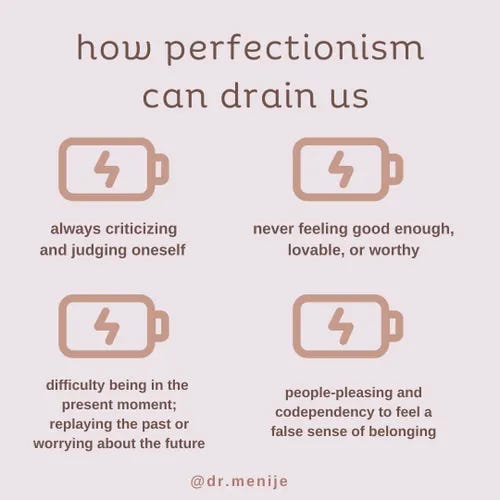
An antidote to perfectionism is learning to embrace imperfection. Other cultures and especially the Eastern religions have embraced imperfection more fully than those of us in the Western world. One example involves the Navajo Nation and their rug weaving culture. Imperfections in Navajo rugs are a fascinating and deeply cultural aspect of Navajo (Diné) weaving tradition. Far from being defects that lower value, many “imperfections” are deliberate and carry spiritual significance.
The Spirit Line (Ch’ihónít’i)
The most well-known intentional imperfection is the “spirit line” (also called spirit pathway). It appears as a single line (or sometimes a dotted or broken line) of a contrasting color that runs from the inner design or center of the rug outward to the edge or border.
Navajo belief holds that when a weaver creates a rug, part of their spirit becomes entwined in the weaving. The spirit line provides a pathway for that spirit to exit the completed rug safely. Without it, the weaver’s spirit could become trapped, potentially causing imbalance, unrest, or harm to the weaver or the rug’s owner.
This feature is common in many traditional Navajo textiles, though it may be subtle and require close inspection.
These intentional flaws honor the divine and acknowledge human imperfection and humility. Collectors and experts note that such “mistakes” do not reduce the rug’s value they can enhance its authenticity and cultural importance.
In short, what might look like a “flaw” to an outsider is often a beautiful expression of Navajo spirituality, humility, and harmony with the universe. Many collectors specifically seek out rugs with clear spirit lines as markers of traditional authenticity.
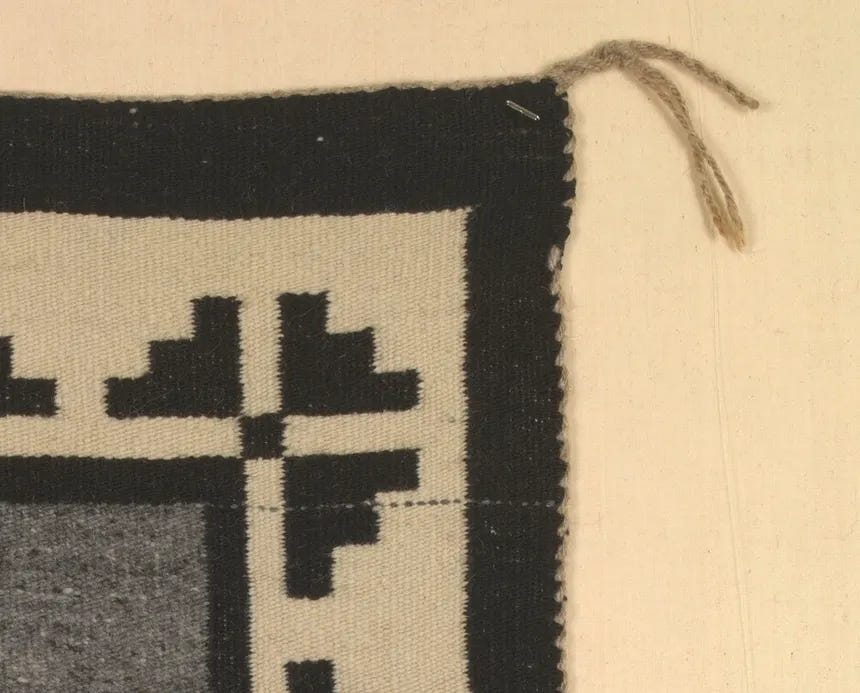
Example of a spirit line
Powerlessness
What is the “cure” for wanting, even needing, everything to be perfect? For me the first step as always is powerlessness. I realize that I am powerless to make all things right. Unfortunately it is often after my being upset that I begin to be aware of my powerlessness in situations. I think that I can be more punctual, that I can correct my penmanship, that I can in fact drive more accurately and so should others! One of my most powerful tools for overcoming perfectionism is my sponsor. I have been meeting weekly with Bill for over twenty-five years, every Tuesday morning. At these meetings I can openly and honestly share my imperfections, my assumed failures, and get them off my chest. Having a caring listener who understands recovery lets the pressure off and opens the door to new insights.
Contemplation
Contemplation, a daily practice of learning to be powerless and allowing life to simply be what it is, helps me in the awareness of reality. Left to my own understanding I am not a good judge of what is a proper response. My self-created world with its own self-created rules is false at its core. Reality is what it is and accepting reality requires me to let go of my fantasy world. This is not a one-time process. I have discovered that I need to let go daily, often several times a day in order to live joyfully in a world of imperfection.
Contemplation can lead me to a place where imperfection is accepted and even embraced, flaws are seen as being good and even a necessary part of an integrated whole. When I examine my own life I find that this is true. When I have grown the most is when I have “failed” in some fashion and the recovery after failure is the learning spurt that was necessary.
If I had not gotten divorced I would never have found recovery. If I had not found recovery I would never have found Beth. If I had not found Beth I would never have embarked on my journey of education and found my life-long career. If I had not embraced my lack of education I would never have accomplished my goals. Julian of Norwich once wrote “First we fall and later we recover from the fall—and both are the Mercy of God.” God in his grace allows me to make mistakes and also teaches me in the midst of recovering from such mistakes.
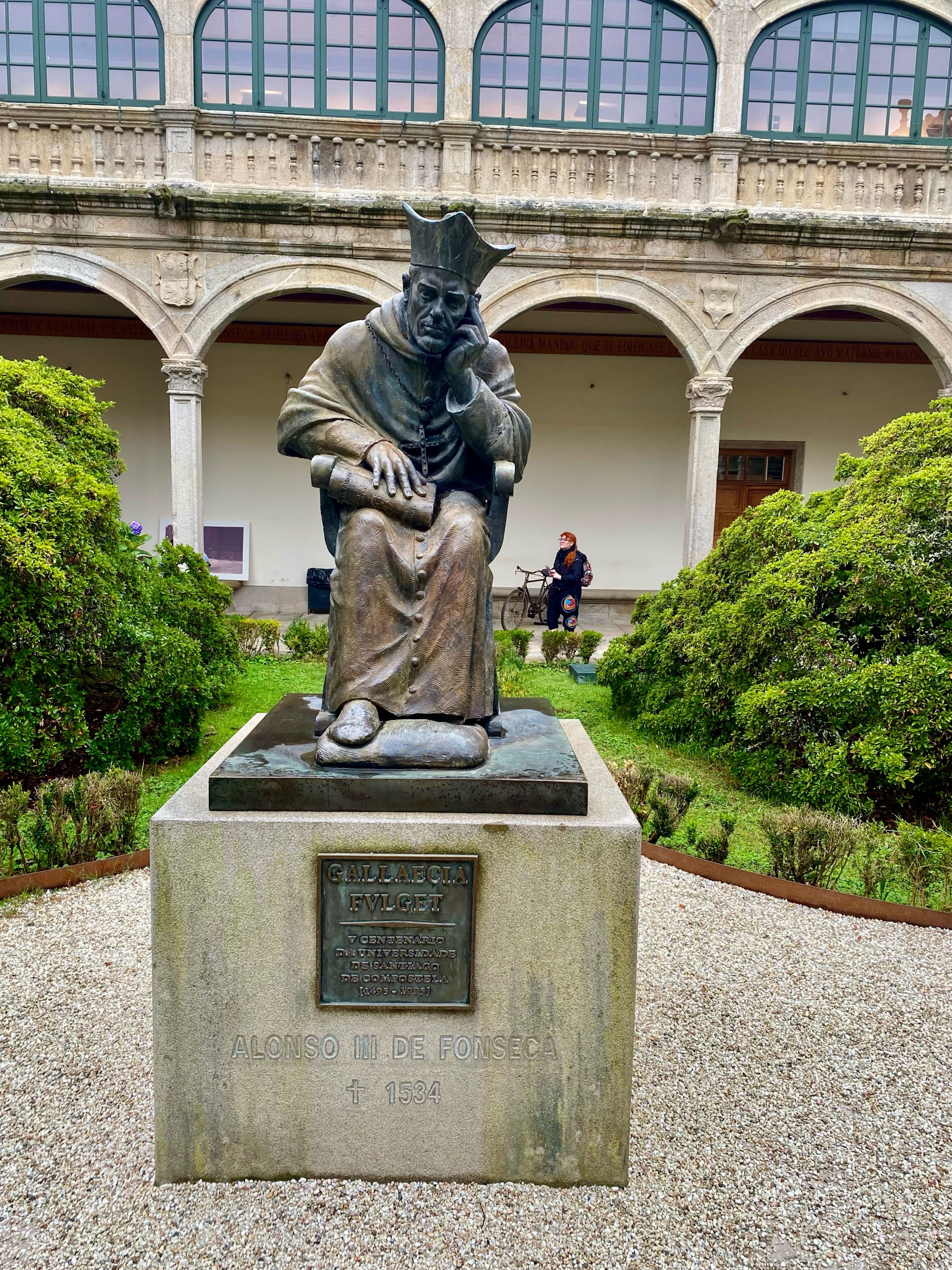
Perfectionism on The Camino
My tendency towards perfectionism comes into play on the Camino. As you might imagine, I try to get everything perfect when I plan. I would love to think that I know exactly what to do and where to go, but the truth is, I don’t. I need help, guides, Camino angels, others to assist me. My most memorable moments from Caminos past happened when things did not go as I had planned. While accepting imperfection feels bad to my ego it is restorative to my soul. Over the next few posts I will be presenting several key steps that I take to help me in overcoming perfectionism as I plan the next Camino.
Once again, planning is not wrong, it is just incomplete. I can never anticipate every variable and even if I could I would limit my experiences to what I already know. As my wise professor told me “If you already knew this material you wouldn’t need to take my class.” This is true in life as well.
Until next time,
I think there's no room for perfectionism on the Camino. And there can't be any on any hiking trail, either, because something is bound to go wrong, and you just have to accept it.
Really good one!
When I need perfection, I hold others to that standard too. Ultimately, this leaves me alone…unable to fulfill one of my basic instincts-the need for community of others.